




Brewing your own beer can be very rewarding. In the first place because of the product, you create, but what might matter just as much: for the skill, knowledge, and creativity you put into it. The process starts by selecting ingredients and heating them in a controlled manner to extract all the sugars (mashing). After cooling down, fermentation begins by adding yeast. When fermentation has finished, you can add hops (dry hopping) or other ingredients to further develop the flavor. Finally, you bottle your brew and wait for it to reach its final form (lagering). Along the way, there’s a lot of cleaning and monitoring involved, to ensure that your beer shines the way you intended it.
Measuring sugar concentration is a key indicator of how your fermentation is progressing. During fermentation, sugars are primarily converted into alcohol and CO2. Th CO2 escapes from the liquid and causes the density to decrease. By tracking the sugar concentration, you can see how far along the fermentation is. It’s hard to determine sugar concentration accurately because of all the other components in the wort. Instead, the density of the wort/beer can be measured, as this is mainly influenced by the changes in sugar concentration. Brewers often use the term “Specific Gravity” (SG), which is the density of the wort compared to the density of water. Alternatively, the wort can be measured optically; the refractive index changes as the sugar concentration changes. This measurement is often expressed in degrees Brix (°Br) or degrees Plato (°P). Although measurement principles are not the same, SG can be converted to °Br or °P and vice versa to give the brewer an indication of how fermentation is progressing. There are additional measurands used for tracking fermentation and on our My Brewbrain platform, you can choose your preferred display unit. So wherever you read SG in this blog, you can substitute it with your preferred measurand.
How can I monitor fermentation remotely?
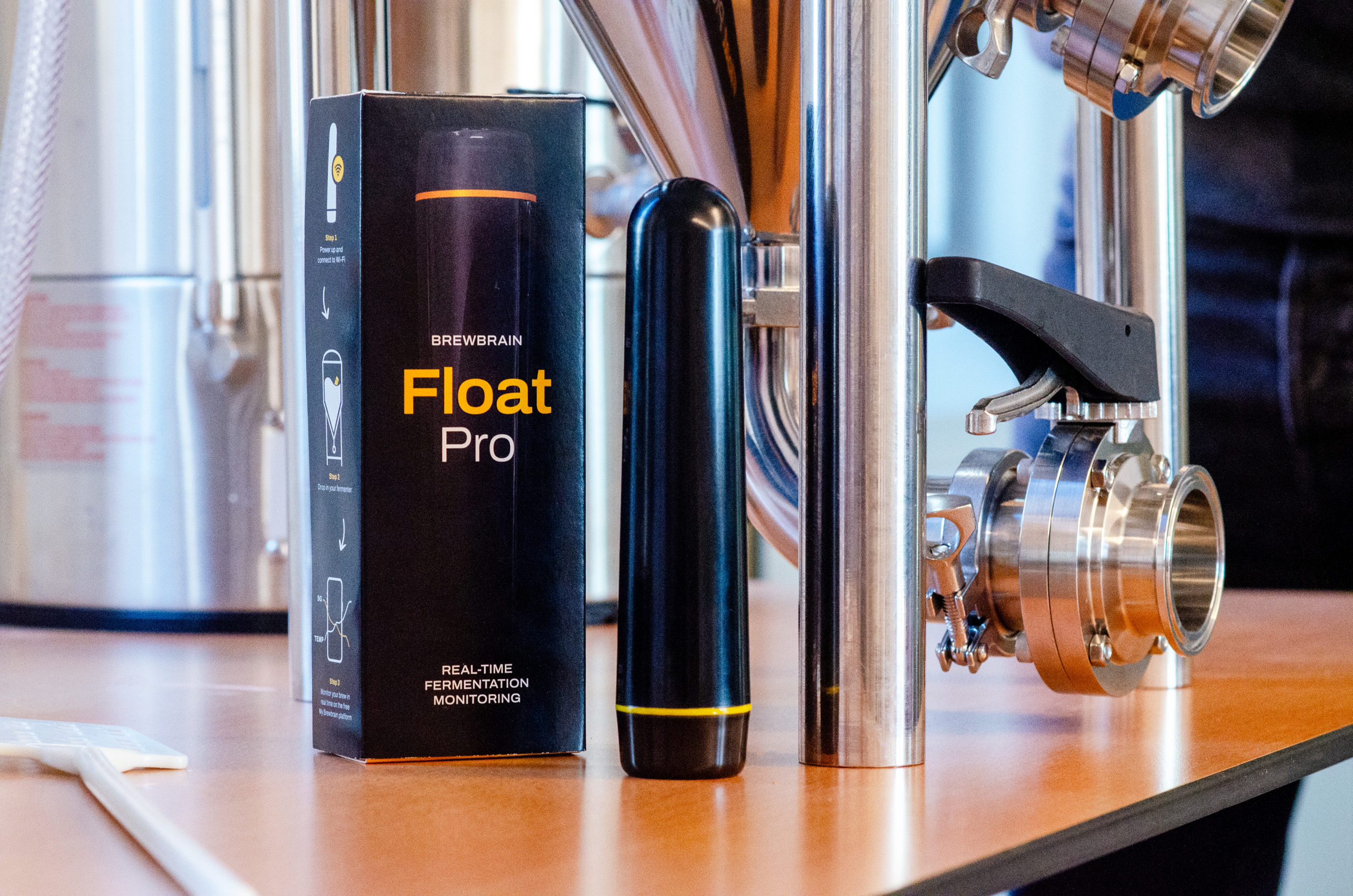
Traditionally, you would take a sample of your fermentation every now and then and measure the Specific Gravity of that sample with a glass hydrometer. Working hygienically, you would discard (after tasting it of course 😊) the sample; by sampling often you reduce the amount of finished product. But with few samples you only see a small part of the journey your brew is on. With the Float Pro you can monitor your brew remotely in our free My Brewbrain platform. The Float Pro automatically measures SG and temperature every 15 minutes so you can follow your brew in real-time. By measuring SG continuously instead of taking only a few samples, you can follow the performance of your yeast and act when needed. And when your brew is finished you can review the measurements to improve your next brew.
What does a typical fermentation curve look like?
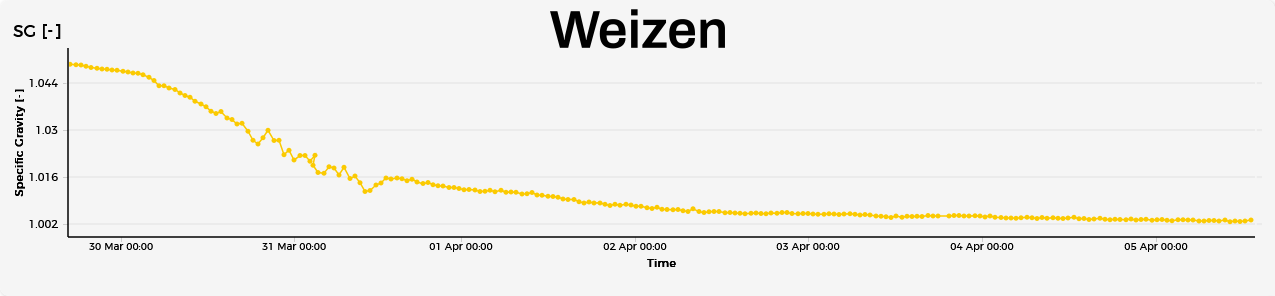
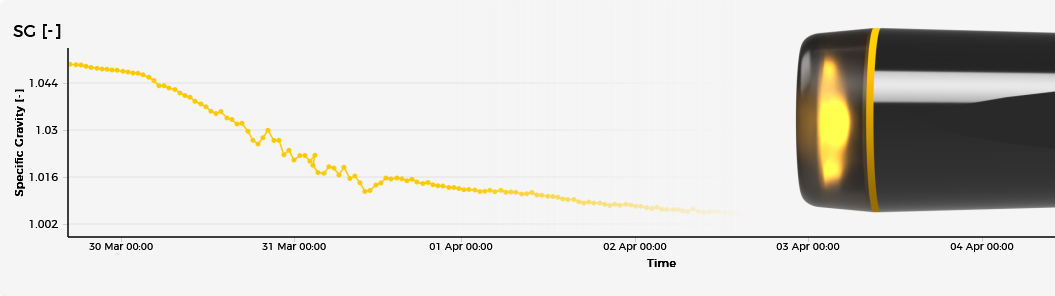
The image above is from an actual brew from the My Brewbrain platform. This brew was based on a recipe for a Weizen beer. My Brewbrain shows real-time fermentation data as gathered by your digital hydrometer.
Let’s first go through the phases of a typical beer fermentation. I’ve laid them out on top of the graph to help visualize them:
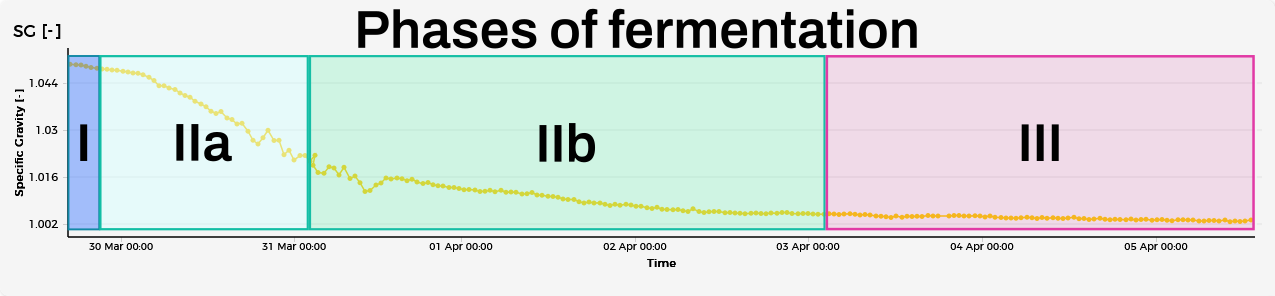
- I Lag phase (0-24 hours): yeast is pitched into the wort. The yeast slowly starts adapting to its surroundings. After that the yeast starts multiplying to reach a high enough population to begin converting sugars. In this phase sugars are only consumed in small amounts and so only a small change in specific gravity can be observed.
- Primary fermentation (1-7 days):
- IIa Start: The yeast is getting it on and eating all that sugar. The SG will drop with increasing speed. Krausen is formed and your airlock will become very active.
- IIb End: Tough luck for the yeast’s sweet tooth; the sugars are being decimated and converting the last ones takes more effort. You will see the SG drop with decreasing speed, and finally come to a standstill as there are hardly any sugars left to convert.
- Secondary fermentation (1-2 weeks):
- III Most sugars are converted, but the yeast has other work to do! It will convert other nutrients into flavors that give your beer character. Specific gravity usually remains constant in this phase.
How does the fermentation curve help me?
Ideally, everything goes well with your brew. You’ve checked regularly and went to bed comfortably, knowing your beer is going to end up just fine! In this case you can use the fermentation graph from your brew as a reference for the next time you make a (similar) brew. If you use an off-the-shelf ingredient kit or a recipe made by someone else, you will likely be advised what starting SG and final SG to look for. Check the start and final specific gravity and compare them to what you expect from your fermentation. If all is well, you can follow the next step in your recipe’s instructions (dry hopping, bottling etc.).
But if something goes wrong during fermentation, you want to act quickly. Here are some examples of issues that you can detect during primary fermentation, when using a Float Pro. The examples won’t cover everything, but hopefully they will help you interpret the data in your graph.
How can I see if fermentation has started?
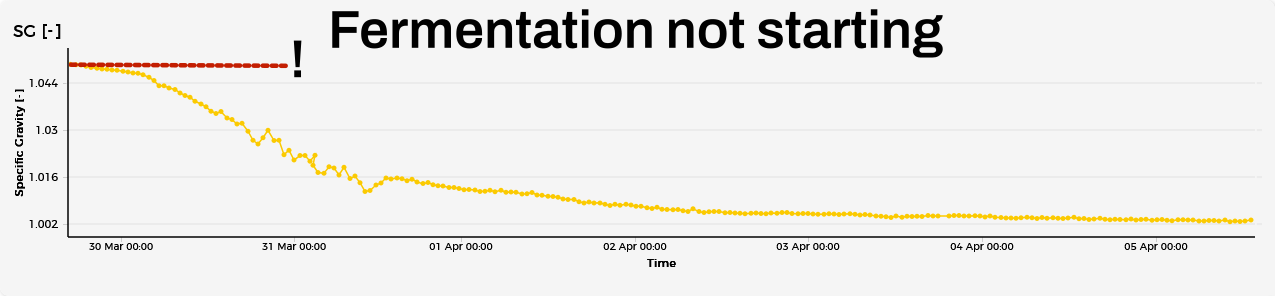
Specific gravity should start dropping after 1-2 days. If this is not the case, you might still be able to save your brew. Typical causes and actions:
- Temperature too low or too high; check the advised yeast temperature and cool/heat to the target temperature
- Under-pitched yeast or old/unhealthy yeast; add the yeast nutrient or pitch additional active yeast.
- Poor oxygenation: your yeast needs more oxygen, gently shake the fermenter and get the yeast back in suspension
Has fermentation stopped early?
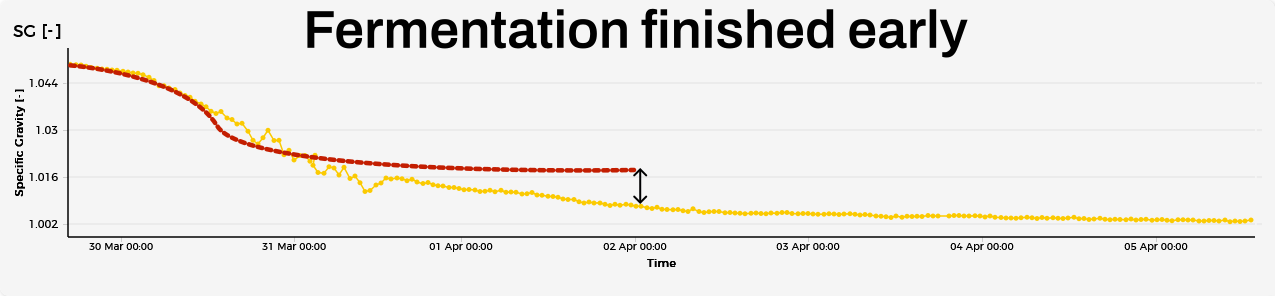
The specific gravity seems to stabilize well above the expected final value. Typical causes and actions:
- Temperature issue; if the temperature went too far off the target, the yeast might have issues performing. Check temperature and cool/heat to correct this.
- Yeast flocculated early; yeast clumps together and so it has less exposed area to the nutrients in the wort/beer. Gently rouse the fermenter or stir with a cleaned tool to resuspend the yeast. Consider increasing the heat slightly to increase activity.
Is my brew fermenting too fast?
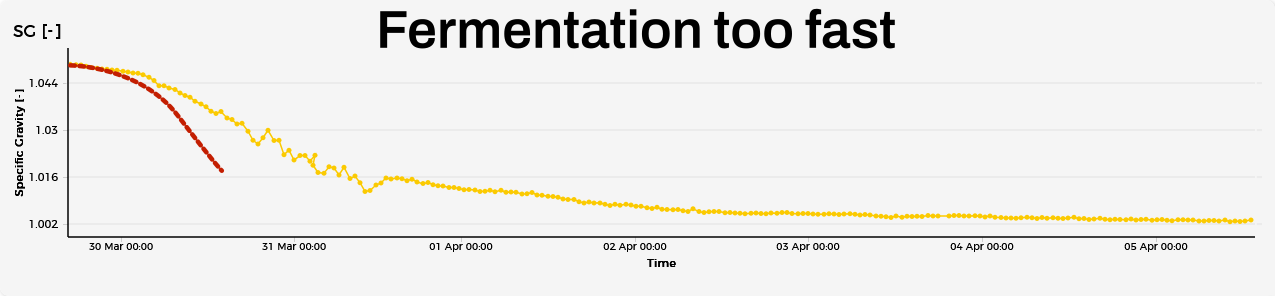
Hold your horses! The specific gravity is going down way too fast. This is likely accompanied by a strong temperature rise. Typical causes and actions:
- High temperature; at higher temperatures, the yeast works faster. Cooling the fermentation slightly can reduce fermentation speed
- Overpitching yeast; because there was too much yeast in the lag phase, converting sugars started early. Cooling the fermentation slightly can reduce fermentation speed
Check your brew often
Every brew is different. Even when using the same ingredients and amounts thereof, there are other factors that will influence the process. If you check the graphs on My Brewbrain often, you will start noticing subtle differences between each brew. The Float Pro digital hydrometer is your visual aid during fermentation.

How to learn faster by sharing your fermentation data?
Track your fermentation with the free My Brewbrain platform. You can even share your brews with your friends. Compare brews and learn from each other! We brewers love to share our knowledge.
This post should give you an idea of how you can look at your fermentation graph. Keep checking our blog as we will write more about what you can learn from your fermentation data.
We love to stay in contact with our brewers so feel free to comment on this blog. Or reach out to us via email at support@brewbrain.nl. We’re there to provide support and are always welcoming your ideas on what to improve next.
Have fun fermenting!
Cheers🍻
Eric Stricker
(Founder/Engineer)